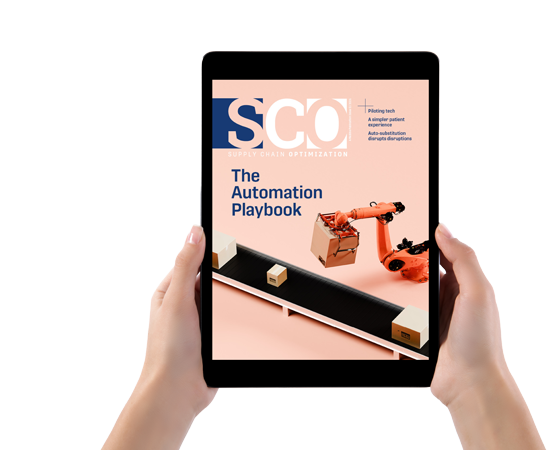
The Future of Supply Chain Intelligence
How AI can help you optimize
 By Dave Kordik
Medline vice president of customer technology solutions
Many challenges in the healthcare industry can be boiled down to one source: data. Sometimes the problem is a lack of data. Sometimes it’s the opposite: a system has grown so large that the sheer amount of data becomes increasingly complex and difficult to manage.
No matter the issue, there’s one common thread to all these data challenges: We’re often too focused on the rearview. Analysts must sift through KPIs or metrics for events that have already taken place, and then retroactively go back and see how an issue could be fixed, or how the figurative bleeding could be stopped.
Supply chain intelligence and the way forward
That’s where a greater emphasis on supply chain intelligence can help healthcare systems achieve better outcomes. With a firehose of data streaming in from a variety of sources, it can be extremely difficult to know if you’re even looking at the right set. But using supply chain intelligence to assess data means you can free up time to tackle larger scale and more impactful projects, like standardizing the practices and products your clinicians use to achieve better patient outcomes.
Supply chain leaders can be more forward-thinking by analyzing risk, then being proactive to mitigate those risks. One of the biggest challenges facing supply chain leaders is developing a resilient supply chain by assessing inventory demand, sourcing products, identifying risk profiles and creating a strategic plan. It’s difficult to predict all of the major geopolitical events that impact sourcing, whether they be storms that shut down supply lines, manufacturing tariffs that cause major pricing disruptions, or other geo-political events disrupting sourcing or moving materials (port shutdowns).
But having a robust understanding of risk profiles can greatly reduce the amount of disruption supply chain leaders face. If you have clear risk profiles, you can formulate a plan for items that face greater risk. Knowing those profiles means we can ask important questions, like what are the proper clinical substitutions that can be stored in case of emergency? How can we ensure that if a disruption takes place, we have a plan in place so there’s no break in continuity for the clinicians?
Supply chain intelligence and heading risk off at the pass
By identifying the risks accurately, no matter what happens, you can be shipped clinically approved product, increasing service rates and getting patients the treatment they need. And once that’s established, you can begin to positively influence your inventory demand. For instance, instead of buying a single product from eight different manufacturers, you can consolidate to one, which helps you better drive both the supply and demand.
That knock-on effect doesn’t stop there. Leaders can not only improve cost savings, but improve revenue, tackling a huge challenge in healthcare settings. Making sure you’re driving the right clinical products for standard clinical processes can provide a solid foundation to help your healthcare facility provide the best care for their patients and fill in the revenue gap.
Medline’s proprietary Mpower™ Foundations tool helps our customers gain valuable real-time visibility to the risk levels of products. It’s able to show supply chain professionals that there may be a problem coming down the line so they can make a plan in advance to avoid backorders. By assessing the health of product lists, an inventory manager can identify a substitution before a problem arises. And while Mpower™ Foundations has already shown to be extremely valuable, it’s just the beginning.
Bringing artificial intelligence to supply chain intelligence
Talk to any CIO or CTO at a major health system, and they will tell you they’ve been hearing how artificial intelligence is going to fix all of their problems for years, to no avail. But the leaps made in generative AI can truly be a game changer for supply chain leaders.
Let’s look at an example. If Medline is a prime vendor for a health system, that means we may be supplying as many as 5,000 different SKUs to that system. As a supply chain leader, if you want to understand the risk associated with those products, that means you have to sift through tens of thousands of SKUs just to determine what you need to focus on first.
So being able to talk to an artificial intelligence assistant and ask it where you should focus your attention—what’s most at risk and what are the suggested substitutions and why—can be a game changer. Letting a generative AI collect that information and make suggestions means decisions can be made much quicker.
Of course, buyers are often not the ones making decisions on products or substitutions. Clinicians need to be able to evaluate and decide. That’s where generative AI can come in, as well. A buyer can not only use AI as a research tool, they can automate how the information is packaged, who needs to see it and how they can approve.
Next gen with Mpower™
In the fall of 2024, Medline announced a partnership with Microsoft called Mpower™, a new generative artificial intelligence solution powered by Microsoft’s Copilot and Azure AI. The partnership leverages the deep data that Medline has as a leading medical and surgical supply manufacturer and distributor. That means supply chain leaders will have easy access to the risk profiles of tens of thousands of SKUs, allowing them to make quick evaluations.
Similarly, with Medline as a market leader, supply chain leaders can get a sense of what products are being used around the country. In the same way someone may shop on Amazon and pick a product based on a recommendation algorithm that identified a popular substitution, Mpower™ is being designed with a similar use in mind.
Planning ahead
Getting to a place where we can make reliable predictions has been the holy grail of supply chain for decades. Taking all of the necessary factors into account: How much of a product is on hand, what is the demand level, what is the lead time for vendors, what’s happening from a geopolitical or a weather perspective. All of those different components can be processed by a generative AI into a simple interface.
That’s where the partnership with Microsoft truly pays off. Having designed customer-friendly software for nearly 50 years, and with so many health systems already running Microsoft 365 applications, the barrier to entry isn’t what it would be otherwise.
And perhaps even more importantly, health systems are not being asked to trust a new software or cloud solution with their data. Given all of the sensitive information stored in healthcare settings, security is the highest concern, and Microsoft meshing with their systems helps alleviate those worries.
Supply chain control tower
As mentioned above, having so many different sources of data, it can be difficult to know which data set will provide the insight you need. That’s where Mpower™ can step in, bringing together myriad data sources kept separately before, and provide the ultimate view of the supply chain while identifying risks. For example, it could bring together manufacturer sourcing data, vendor shipment data, provider on-hand inventory data, OR schedules, and other demand signals all to make sense of a provider’s specific supply chain.
The future of Mpower™ is to operate as a supply chain control tower. It’s a solution that can not only predict risk profiles and communicate them, but also optimize the supply chain. It can make suggestions for product standardization, contract maximization and inventory management where supply chain leaders won’t have to wait for demand signals. It’s all about reducing administrative burden, automating processes, and making everything simple and efficient for our partners.